2026 Fantasy Football RB Tiers: PPR Draft Guide and Strategy

The Snap’s updated 2026 running back tiers group the top PPR options by draft decision, role, market price, and risk. Use the board to recognize tier breaks without forcing a running back ahead of better value.
Correction and update (July 27, 2026): This page has been rebuilt as The Snap’s independent 2026 PPR draft board. It now explains the scoring assumptions, separates player value from draft price, and cites the public rankings, projections, and ADP inputs used for the update.
Running back tiers are decision tools, not a promise that every player in one row will finish together. The useful question is whether the next back offers enough value to pass on a stronger wide receiver, tight end, or quarterback. This board is designed for 12-team, full-PPR redraft leagues and should move as roles, health, and average draft position change.
#How these 2026 RB tiers were built
The Snap combined role expectations, receiving involvement, touchdown opportunity, age and health risk, team context, public projections, expert rankings, and current PPR draft cost. Tiers matter more than false precision: players in the same tier can be reordered for a specific roster without pretending the fifth-ranked back is meaningfully safer than the sixth.
The draft windows below are market guides, not rigid instructions. If a tier falls beyond its usual price, that is useful information. If the room pushes a player well above it, compare the opportunity cost before following the run.
| Tier | Players | Current 12-team PPR draft window | Draft action |
|---|---|---|---|
| 1 — Elite anchors | Bijan Robinson (ATL); Jahmyr Gibbs (DET) | First three picks | Take either as an all-format foundation. Do not overthink the order. |
| 2 — Volume-plus foundations | Christian McCaffrey (SF); Jonathan Taylor (IND) | Round 1 | Choose McCaffrey for receiving ceiling and Taylor for projected rushing volume. |
| 3 — Upside RB1 cluster | De’Von Achane (MIA); Ashton Jeanty (LV); James Cook (BUF); Chase Brown (CIN); Omarion Hampton (LAC) | Round 1 to early Round 2 | Use roster build and scoring format as the tiebreaker. |
| 4 — Price-sensitive RB1/RB2s | Saquon Barkley (PHI); Kenneth Walker III (KC); Derrick Henry (BAL); Breece Hall (NYJ); Kyren Williams (LAR); Josh Jacobs (GB); Jeremiyah Love (ARI) | Late Round 1 through Round 3 | Draft the role at a discount; do not pay ceiling price for unresolved age, health, rookie, or availability risk. |
| 5 — RB2 and flex bets | Javonte Williams (DAL); Travis Etienne Jr. (NO); Cam Skattebo (NYG); Bucky Irving (TB); Quinshon Judkins (CLE); D’Andre Swift (CHI); David Montgomery (HOU); TreVeyon Henderson (NE) | Rounds 3–6 | Pair with an elite anchor or strong WR start rather than treating them as interchangeable. |
#Tier 1: Complete anchors
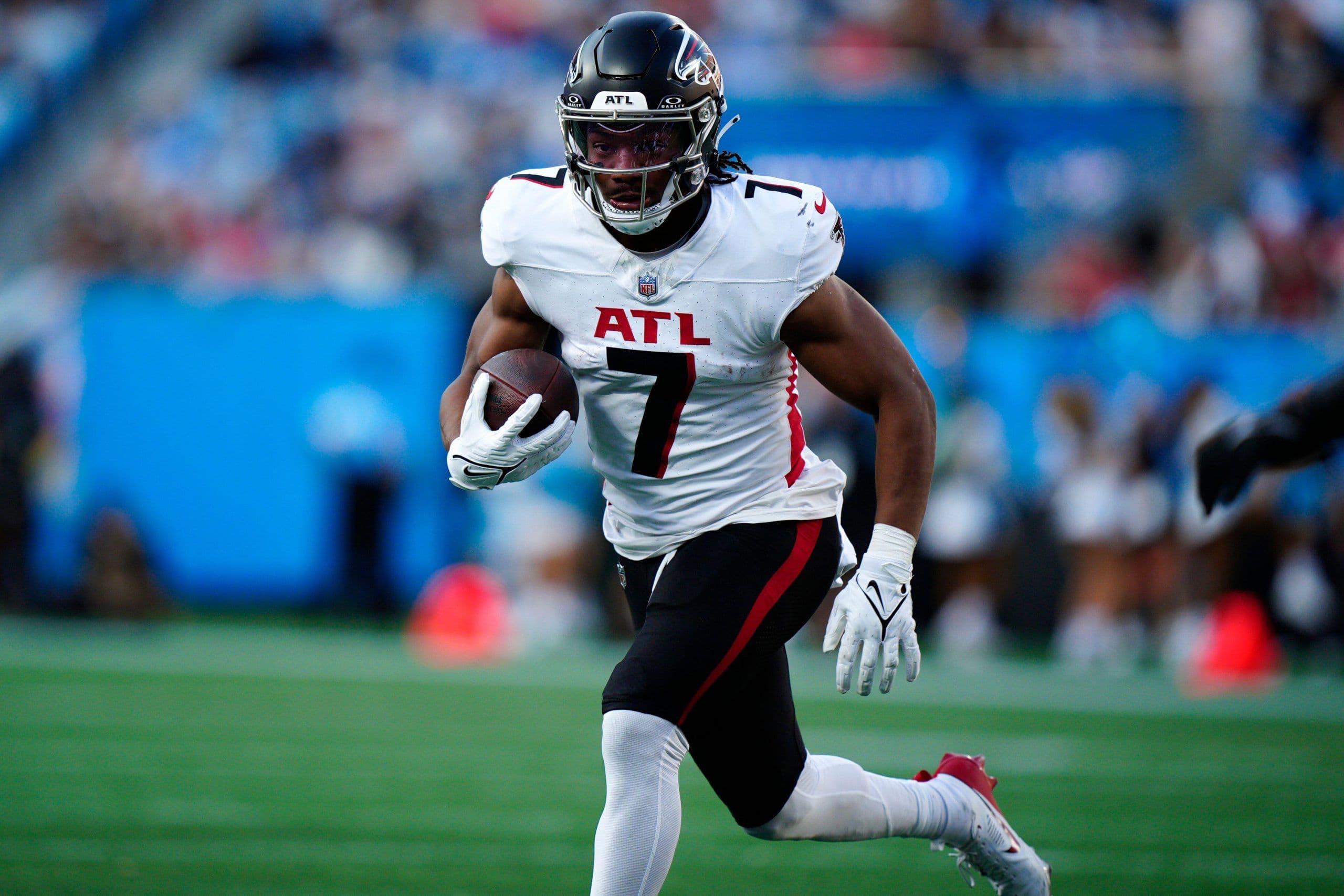
Bijan Robinson and Jahmyr Gibbs offer the cleanest combination of rushing talent, receiving value, touchdown access, and week-winning ceiling. Either can anchor Hero RB, balanced, or running-back-heavy builds. The decision between them is a preference, not a reason to abandon the rest of the board.
#Tier 2: Workload or receiving ceiling
Christian McCaffrey and Jonathan Taylor remain Round 1 foundations for different reasons. McCaffrey’s receiving work can create a PPR advantage when healthy. Taylor’s case leans more heavily on projected rushing volume and scoring opportunity. Managers should price the distinct risks instead of flattening both players into the same profile.
#Tier 3: Different profiles, similar value
De’Von Achane brings explosive receiving upside; Ashton Jeanty and Omarion Hampton bring youth and workload ceilings; James Cook and Chase Brown can win through efficient, high-value usage. Because their paths differ, league settings and the first pick should break ties. A receiver-first start may favor the safer touch projection, while an early running back can justify chasing more volatility.
#Tier 4: Price is part of the projection
Saquon Barkley, Kenneth Walker III, Derrick Henry, Breece Hall, Kyren Williams, Josh Jacobs, and Jeremiyah Love all have credible RB1 outcomes. They also carry questions involving age, health, role, team change, rookie translation, or draft price. That makes the acquisition cost inseparable from the ranking. This tier becomes attractive when the room discounts a risk already reflected in the projection.
#Tier 5: Build combinations, not isolated bets
Javonte Williams, Travis Etienne Jr., Cam Skattebo, Bucky Irving, Quinshon Judkins, D’Andre Swift, David Montgomery, and TreVeyon Henderson belong in the RB2 and flex conversation, but not for identical reasons. Some rely on stable touches, others on receiving work, touchdown roles, or a path to a larger share. Pair complementary bets instead of drafting several backs who all need the same game script.
#Scoring format can move players
Full PPR rewards target volume and can elevate backs who stay involved on third down or in two-minute situations. Half-PPR narrows that advantage. Standard scoring shifts more value toward rushing volume and goal-line work. Bonuses, first-down scoring, lineup size, and flex rules can also change how aggressively a manager should attack the position.
Use these tiers alongside The Snap’s complete fantasy football draft strategy guide and the Hero RB strategy explainer, rather than choosing a roster structure before seeing the board.
#Draft plans by starting position
| Starting slot | Opening-round plan | Running back trigger |
|---|---|---|
| Picks 1–3 | Take an elite anchor when Robinson or Gibbs is available | Do not force RB2 if stronger receiver value survives the turn |
| Picks 4–8 | Compare Tier 2 with the elite WR tier | Use receiving ceiling, workload confidence, and league scoring as tiebreakers |
| Picks 9–12 | Stay open to WR-WR, RB-WR, or an RB value at the turn | Attack Tier 3 only when the cost fits; do not chase the end of a run |
#What should change these tiers
- Confirmed injuries, recovery setbacks, or meaningful workload restrictions
- Depth-chart changes that alter early-down, passing-down, or goal-line roles
- Material offensive-line, quarterback, or scheme changes that affect scoring chances
- A large ADP move that changes the opportunity cost, even when the football projection stays the same
- League settings that reward receptions, first downs, long touchdowns, or unusually deep starting lineups
#FAQ
#Should I draft a running back in Round 1?
Draft a Round 1 running back when the player belongs in the same overall value tier as the best alternatives and fits the roster plan. Do not take one only because the position feels scarce; a forced pick can create a deficit at wide receiver without eliminating running back risk.
#How many running backs should I draft?
Most one-quarterback redraft teams should leave with enough backs to cover two starters while preserving multiple upside paths on the bench. The exact number depends on lineup size, bench depth, waiver activity, and whether the early picks already supplied a dependable anchor.
#When should I update my tiers?
Update after meaningful news, not every social-media rumor. Training-camp usage, injury information, preseason roles, transactions, and major ADP movement can change a decision. Record the date and scoring assumptions so an old board is never mistaken for a current one.
#Sources and market inputs
Player grouping cross-check: NFL.com’s 2026 fantasy football RB draft tiers and analysis.
Projection cross-check: ESPN’s 2026 fantasy football projections.
Expert ranking cross-check: FantasyPros PPR running back consensus rankings.
Market-price cross-check: Fantasy Football Calculator 12-team PPR running back ADP.
Additional methodology comparison: Sharp Football Analysis running back tiers. The table, tier decisions, and draft actions on this page are The Snap’s synthesis.
Related coverage