
How to Read NFL Betting Odds: Spreads, Moneylines, Totals, and More
Learn how to read NFL betting odds in plain English, including point spreads, moneylines, totals, -110 pricing, implied probability, line movement, parlays, props, teasers, and futures.
#NFL betting odds at a glance
NFL betting odds look intimidating until you know what the numbers are actually saying.
At the simplest level, odds do two things at once: they show how a sportsbook prices each side of a bet, and they hint at how likely that outcome is considered to be. Once you understand spreads, moneylines, totals, and the built-in sportsbook fee, the board starts to make sense fast.
If you are new to NFL betting, this is the place to start.
#What NFL odds are really telling you
Odds are not just predictions. They are prices.
Sportsbooks set odds to reflect team strength, injuries, matchup context, recent form, and expected betting action. The goal is not just to guess the score correctly. The goal is to post a number that attracts balanced action while protecting the book.
That is why a strong team might be favored by less than casual fans expect, or why a line can move even if the teams themselves have not changed.
In other words, odds are a market, not a power ranking.
#How NFL point spreads work
The point spread is the most common NFL bet.
It is designed to even the matchup by giving the underdog extra points and forcing the favorite to win by a certain margin.
Example:
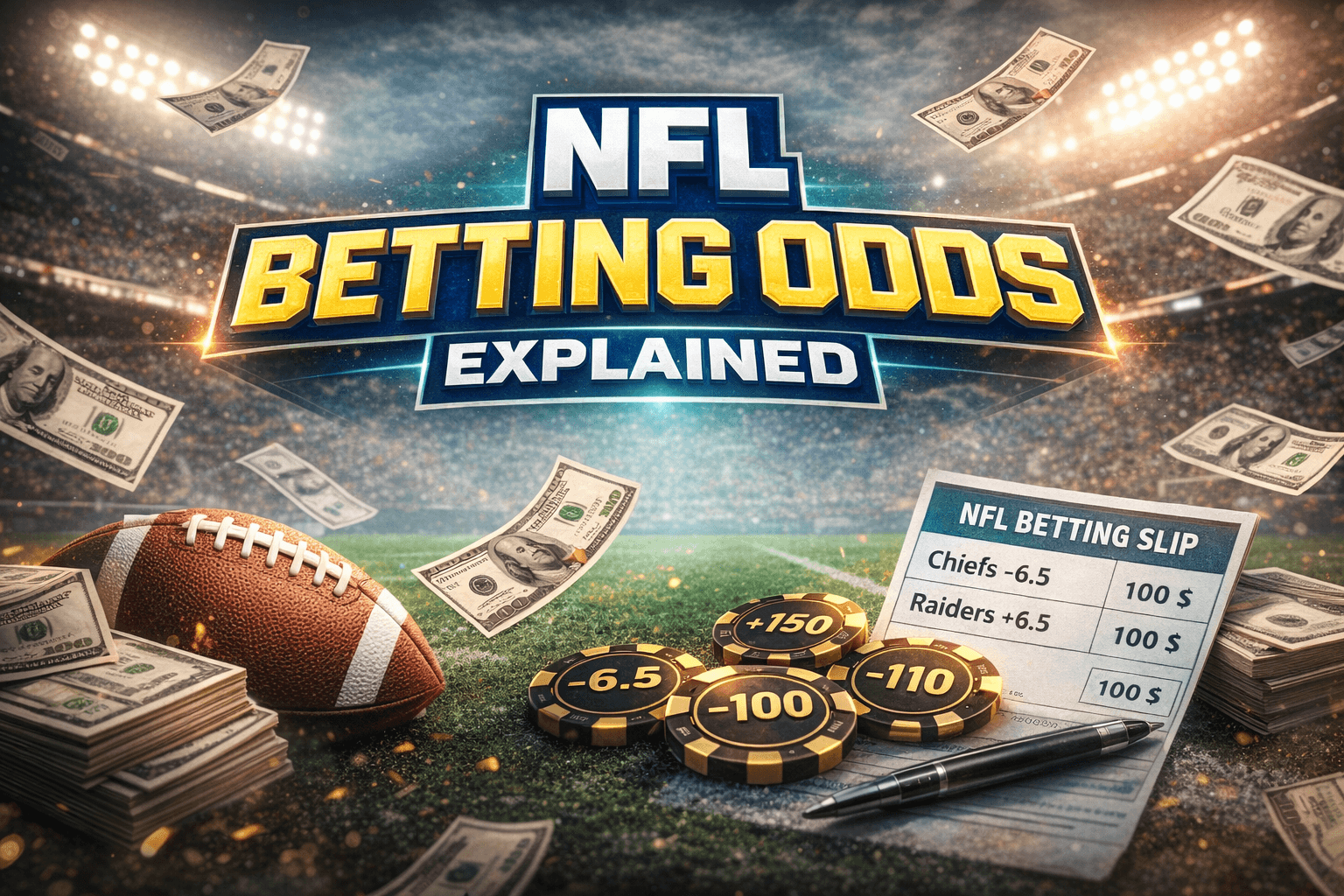
- Chiefs -6.5
- Raiders +6.5
If you bet the Chiefs at -6.5, they have to win by 7 or more for that bet to cash.
If you bet the Raiders at +6.5, they can either win outright or lose by 6 or fewer.
The spread matters because it turns a simple question, “Who will win?”, into a sharper question: “By how much?”
That is a big deal in the NFL, where one-possession games are common and margins matter.
#How NFL moneyline bets work
The moneyline is the straight-up winner bet.
You are not dealing with a point margin. You are only picking which team wins the game.
Example:
- Bills -180
- Dolphins +150
The Bills are the favorite. A -180 moneyline means you would need to risk $180 to profit $100.
The Dolphins are the underdog. A +150 moneyline means a $100 bet would profit $150.
Favorites have minus numbers because the return is smaller. Underdogs have plus numbers because the return is larger.
If you just want to bet the winner without worrying about the spread, the moneyline is the cleanest option.
#How NFL over/under totals work
The total is a bet on the combined points scored by both teams.
Example:
- Over 47.5
- Under 47.5
If the final score is 27-24, the game lands on 51 total points, so the over wins.
If the final score is 23-20, the game lands on 43 total points, so the under wins.
Totals are shaped by pace, quarterback play, weather, offensive explosiveness, defensive quality, and game script. A matchup between two aggressive passing offenses will usually carry a higher total than a game expected to be slow, physical, and run-heavy.
#What does -110 mean?
You will see -110 on a lot of spread and total bets.
That number is the price, often called the juice or vig.
A standard -110 line means you risk $110 to win $100 in profit. If you bet $11, you win $10. If you bet $22, you win $20.
That extra charge is how sportsbooks make money.
It also means you do not just need to be right half the time to break even. At -110, you need to win a little more than 52 percent of your bets long term to stay profitable.
That detail matters more than most beginners realize.
#How NFL odds show implied probability
Odds can also be translated into implied probability, which is just a way of expressing the market’s view in percentage form.
A negative number like -200 implies a higher chance of winning than a positive number like +200.
Quick examples:
- -200 implies the team is expected to win much more often
- +200 implies the team is viewed as a clear underdog
- -110 implies a near coin-flip after accounting for the sportsbook’s cut
You do not need to calculate implied probability by hand every time, but it helps to remember this: the odds are a price on an outcome, and every price carries an expectation.
#Why NFL odds move
Lines move for a reason.
Sometimes it is obvious, like a starting quarterback injury or a major weather shift. Sometimes it is quieter, like respected betting action forcing the book to adjust.
Common reasons NFL odds move:
- Injury news
- Weather changes
- Rest and travel spots
- Matchup-specific betting interest
- Heavy action on one side
- Market correction after an opening number was posted
A line moving from -3 to -4.5 is not random. It usually means the market found the opener too cheap on the favorite, or something changed that made that side stronger.
#How parlays work
A parlay is a combination of multiple bets tied together on one ticket.
Instead of betting each outcome separately, you bundle them into one wager. The upside is a larger payout. The downside is that every leg has to win.
For example, a parlay might include:
- Bills moneyline
- Chiefs -3.5
- Over 47.5 in another game
If two legs win and one loses, the whole parlay loses.
That is why parlays are so popular but so difficult to hit consistently. The payout can look great, but the margin for error is tiny.
#How prop bets work
Prop bets, short for proposition bets, focus on specific outcomes inside a game rather than the final result.
Common NFL prop examples include:
- a quarterback’s passing yards
- a running back’s rushing attempts
- whether a receiver scores a touchdown
- which team scores first
- whether a defense records an interception
A prop bet might be listed as:
Under 249.5 (-114)
Props are popular because they let bettors build opinions around matchups, roles, injuries, and player usage instead of just betting the game itself.
#How teasers work
A teaser is a type of parlay that lets you adjust the spread or total in your favor.
If you take a six-point teaser, the lines move by six points. For example:
- Colts +6.5 becomes +12.5
- Cowboys -4 becomes +2
That makes each leg easier to win, but the payout is reduced compared to a normal parlay.
Teasers are popular in football because moving through key numbers can matter a lot more than in some other sports. They are still combination bets, though, so multiple legs must still win.
#How futures bets work
Futures are long-term bets on outcomes that will be decided later in the season.
Examples include:
- Super Bowl winner
- conference winner
- division winner
- regular-season win totals
- awards like MVP or Offensive Rookie of the Year
A futures bet stays open for weeks or months, which makes it very different from betting a single game. The payout can be attractive, but your money is tied up much longer.
#How beginners should read an NFL odds board
If you are just starting out, focus on the first three markets:
- spread
- moneyline
- total
Those are the cleanest and easiest to understand. Once you are comfortable with those, props, parlays, teasers, and futures become much easier to evaluate.
The biggest mistake new bettors make is chasing big payouts before they understand what the market is asking. A big number does not automatically mean good value. You still need to understand the probability behind the price.
#The biggest mistake beginners make
The most common mistake is confusing “I think this team is better” with “this is a good bet at this number.”
A team can be the better team and still be overpriced.
That is the whole game. Betting is not only about picking winners. It is about deciding whether the number is worth betting.
The NFL is especially tricky because the league has parity, injuries change everything fast, and one score can swing a spread at the end.
Understanding the number matters as much as understanding the teams.
#NFL betting odds FAQ
#What does -110 mean in NFL betting?
It means you need to risk $110 to win $100 in profit. If your bet wins, you also get your original stake back.
#What is the difference between a spread and a moneyline?
A spread bet is about margin of victory, while a moneyline bet is simply about who wins the game.
#What is a push in NFL betting?
A push happens when the result lands exactly on the betting number, and the sportsbook refunds the wager instead of grading it as a win or loss.
#Are parlays better than straight bets?
Not necessarily. Parlays offer larger payouts, but they are much harder to hit because every leg has to win.
#What is the easiest NFL bet for beginners?
Most beginners should start with moneylines, spreads, and totals before moving into props, teasers, and parlays.
#Key NFL betting terms
#Vig
The sportsbook’s price on a bet, often shown as odds like -110.
#Cover
When a team beats the point spread.
#Push
A refunded bet after the result lands exactly on the line.
#Moneyline
A bet on the team that will win outright.
#Total
A bet on whether the combined score goes over or under the listed number.
Next: Browse The Snap's NFL betting hub for current futures, win totals, odds analysis, and related explainers.
Remember: Betting outcomes are uncertain. Set limits and never risk money you cannot afford to lose.
#Final takeaway
NFL betting odds are easier to read once you know what each market is asking.
The spread asks how much a team will win by. The moneyline asks who wins. The total asks how many points the game will produce. The juice tells you what it costs to make the bet.
Once those pieces click, the board stops looking like random numbers and starts reading like a pricing sheet for the game.
That is the first step to making smarter decisions, whether you are betting seriously or just trying to understand what the market is saying about an NFL matchup.
Latest coverage
More from The Snap
- 01
- 02
- 03
- 04
- 05